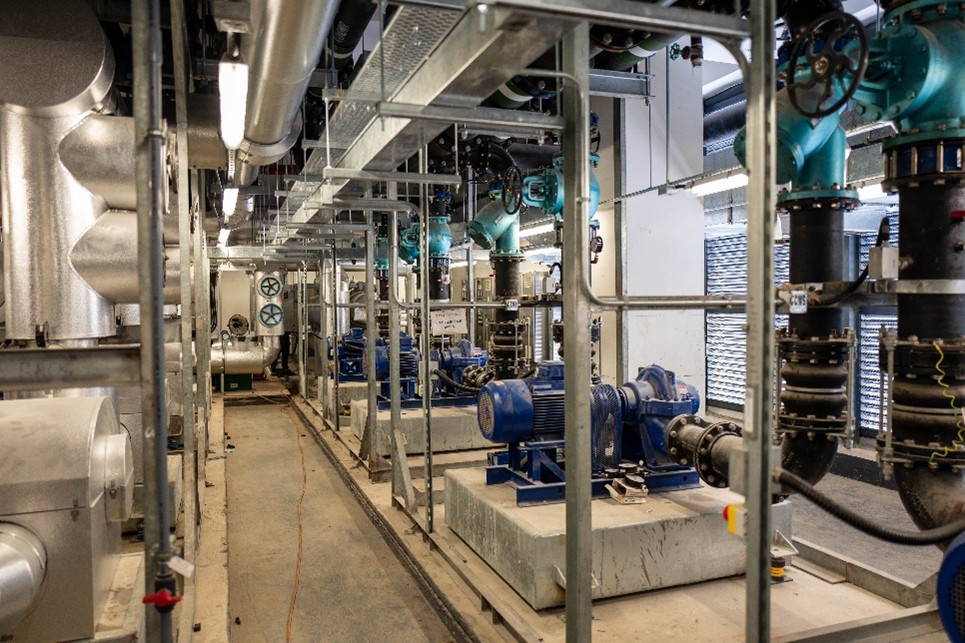
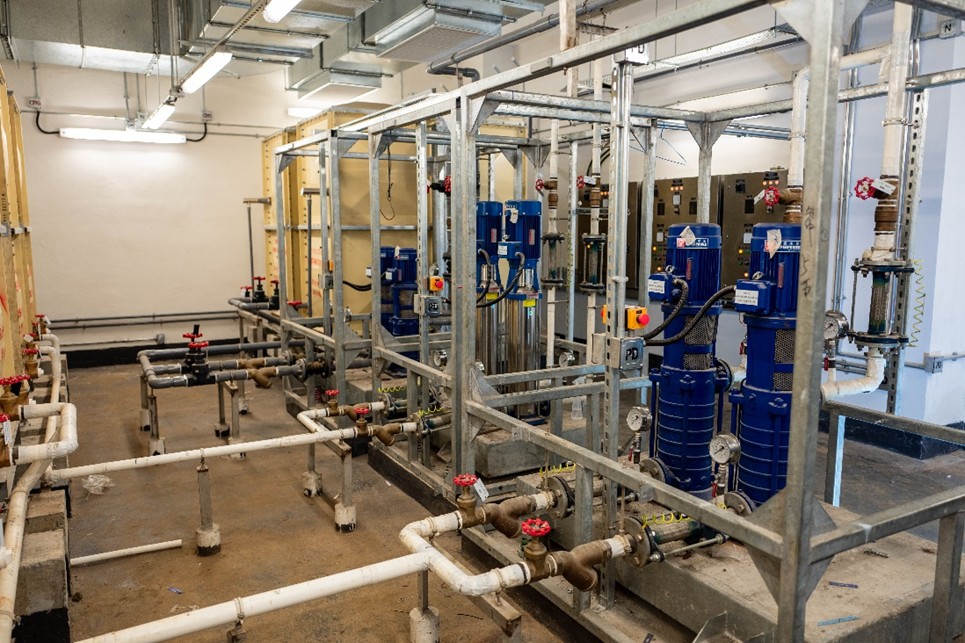
To encourage a wider adoption of MiMEP, the vetting criteria of the Construction Innovation and Technology Fund (CITF) of requirements on the number of stories and MiMEP installation area was removed. MiMEPs projects which can demonstrate its merits will be considered by the MiC-VSC. The CITF hopes the relaxation can encourage project consultants to initiate MiMEP design in the early stages of the project, and encourage E&M subcontractors to design and modules to enhance the efficiency of building services installations.
CITF has invited ATAL Engineering Company Limited (ATAL) to share with us their experience in adopting the “MiMEP” in construction projects. They share their first MiMEP project, the “Architectural Services Department - Reprovisioning of Fu Shan Public Mortuary at Sha Tin”.
Fu Shan Public Mortuary in Shatin is now the largest public mortuary building in Hong Kong, with a construction floor area of approximately 18,200 square meters. With a view to shortening the construction duration and improving the efficiency of the project, ATAL proposed an optimised option applying MiMEP and Building Information Modelling (BIM) throughout the reprovisioning project. The MiMEP modules are mainly installed in the Main Switch Room, AHU Room, Chiller Plant Room, Cooling Tower Plant, Water Pump Room, FS Pump Room, as well as in the equipment corridor and MEP Pipe Duct.
First, in terms of productivity enhancement, the prefabrication of modules in the factory can be carried out simultaneously with on-site construction, which significantly reduces the duration required for on-site work and accelerates the overall progress. In addition, systematic production in the factory reduces the reliance on on-site labour and mitigates the shortage of skilled workers. Moreover, modular design can reduce design changes and avoid coordination delays as compared to traditional construction.
As for improving quality, prefabricated modules in the factory can strictly control the process quality to ensure the accuracy of module components. In addition, automated production process (such as mechanical welding and automatic pipe cutting machines) reduces manual errors and improves structural consistency. Furthermore, the comprehensive quality testing (QA/QC procedures) must be completed before the module leaves the factory to reduce on-site rectification.
With respect to enhancing safety, modular installation only requires lifting and connection on site, reducing the time workers are exposed to dangers in the environment (reducing high-risk processes such as working at heights and operating heavy machinery), effectively reducing risks on site.
Last but not least, in terms of environmental performance, the accurate calculation on the use of materials in the factory significantly reduces the waste compared to that of traditional construction methods. A shorter duration required also further reduces energy consumption, while the use of renewable energy (such as solar panels for power supply) in factory makes the project more environmentally friendly. In addition, the design of modules can add in structures that can be disassembled and reused to further reduce waste. The reduction of work processes on-site also means that the noise and dust pollution generated by the project can be lowered, minimising the impact on the surrounding neighbourhood.
ATAL believes that the enhancement measures of the CITF will provide a great impetus for the industry to apply MiMEP more widely and effectively. Although MiMEP can help reduce the manpower demand for on-site construction and shorten the construction duration, it requires additional investment in establishing MiMEP manufacturing facilities, logistics and transportation, and inventory management. If CITF only supports MiMEP projects meeting a certain scale, it may discourage the industry from considering MiMEP adoption.
Some developers and practitioners who are interested in MiMEP technology would only confine a small part of their projects, such as the machine room, pipelines, etc. for pilot trials. Yet, the previous funding framework of the CITF has excluded projects of small scale from funding coverage. Therefore, the relaxation on the vetting criteria that any MiMEP projects serving CITF objectives could be supported is a significant boost to the industries on MiMEP adoption.