We provide Construction Workers Registration service, and introduce Registered Specialist Trade Contractors Scheme as well as the Technically Competent Persons Registration Scheme to the construction industry.
We provide Construction Workers Registration service, and introduce Registered Specialist Trade Contractors Scheme as well as the Technically Competent Persons Registration Scheme to the construction industry.
For many, ‘home’ means more than four walls and a roof; it's about creating a sense of belonging and fostering community. Housing provides society with support and hope, which makes devising housing policy a long and arduous task.
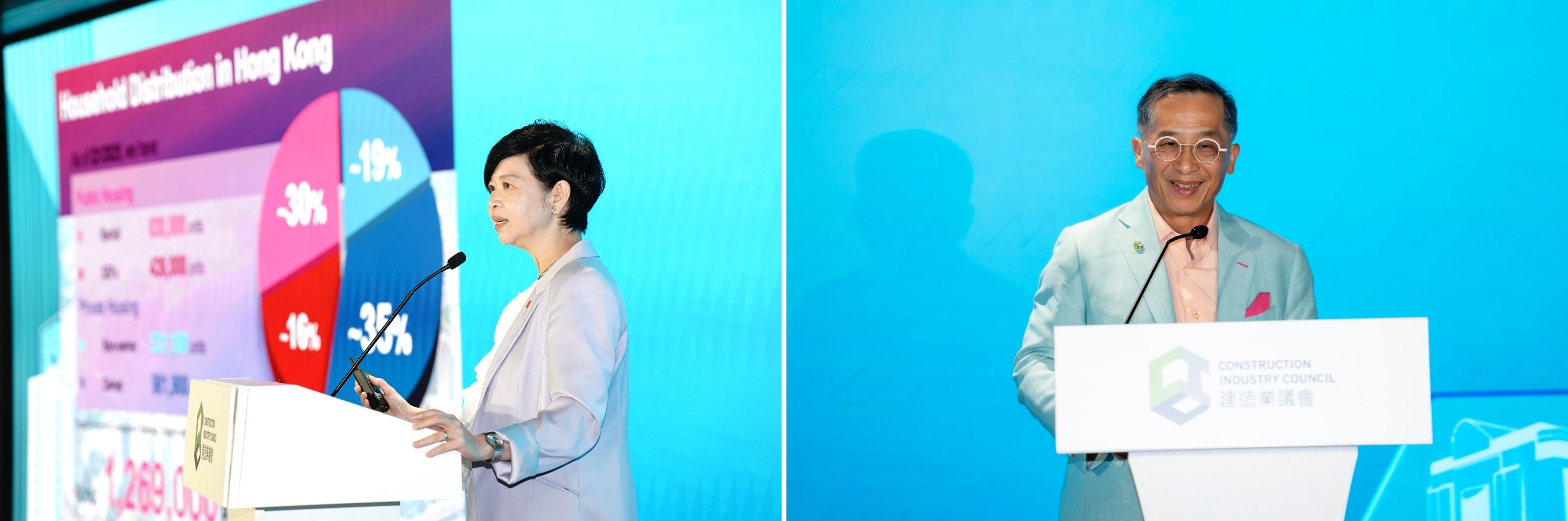
In her recent speech at CIC – See What I See, Secretary for Housing, Ms. Winnie HO, stated that approximately 30,000 Light Public Housing units are expected to be completed in the next two years, with the first batch of 2,100 units in Yuen Long already completed and put into use. Over 300,000 units are expected to be completed in the next 10 years. But as well as quantity, housing quality is also crucial. As Ir Prof Thomas HO, Chairman of the Construction Industry Council, pointed out, "Good housing design must integrate innovative technology and a people-centred approach to improve living standards and bring happiness.
“One of the biggest challenges facing society today is the issue of subdivided flats. Implementing Light Public Housing and a regulatory system for subdivided flats is a bold move to improve the problem of substandard housing, and reflects the government's determination to improve the living environment of vulnerable groups."
Regarding innovative technology, Ms. HO stated, "In the future, the government will collaborate more closely with industry, academia, universities and research institutions. We hope the Housing Department will provide a platform for these institutions to exchange ideas, strengthen connections, and work together to achieve our goals."
Ir Prof. Thomas HO emphasised how future construction must integrate innovative technology and introduce robotics to address safety and productivity challenges, contributing to the transformation of Hong Kong's construction industry. "Technology should not just be a tool, but a means to improve our quality of life," he added.
Ms. HO explained that the government has signed a memorandum of understanding with the Nano and Advanced Materials Institute to develop high-strength lightweight concrete technology and soundproof building materials for Modular Integrated Construction (MiC). It has also collaborated with the Hong Kong Applied Science and Technology Research Institute to develop a smart tower crane equipped with 5G, optical tracking and remote control capabilities, and is engaged in academic cooperation with the University of Hong Kong to digitalise the MiC process. The latter will allow project managers to monitor prefabricated modules at the factory, their transportation and on-site assembly in more systematically and accurately. Regarding residential interiors, in addition to the MiMEP 2.0 method, the government is also collaborating with the Hong Kong Centre for Construction Robotics to develop construction robots, such as for painting and welding, to reduce the need for high-risk work, enhance site safety, and protect workers’ health.
Indeed, as Ms. HO indicated, many housing projects will soon adopt painting robots, and she has already previewed a variety of types. In the future, she hopes developers will use a variety of robots for higher-risk work at different stages of construction, such for painting exterior walls. "I believe many industry managers here are very concerned about safety,” she said. “With the assistance of these robots, efficiency can be improved while reducing the accident rate."
In property maintenance and management, the application of drones and AI is even more extensive. For example, drones can penetrate lift shafts to pinpoint problems before scheduling repairs, minimising risks during reconnaissance. Most housing estates have surveillance cameras to prevent objects from being dropped from heights, but in the event of such incidents, it usually takes several hours to find the relevant footage. With AI, the search time can be reduced.
In addition to exchanging ideas with local industry professionals, Ms. HO has led industry leaders on visits to various cities in mainland China, France, Spain and Portugal in recent years. She stated, "Under the government's leadership and with the help of the CIC to unite the industry, we hope to make Hong Kong a super-connector for pioneering new areas in housing construction."
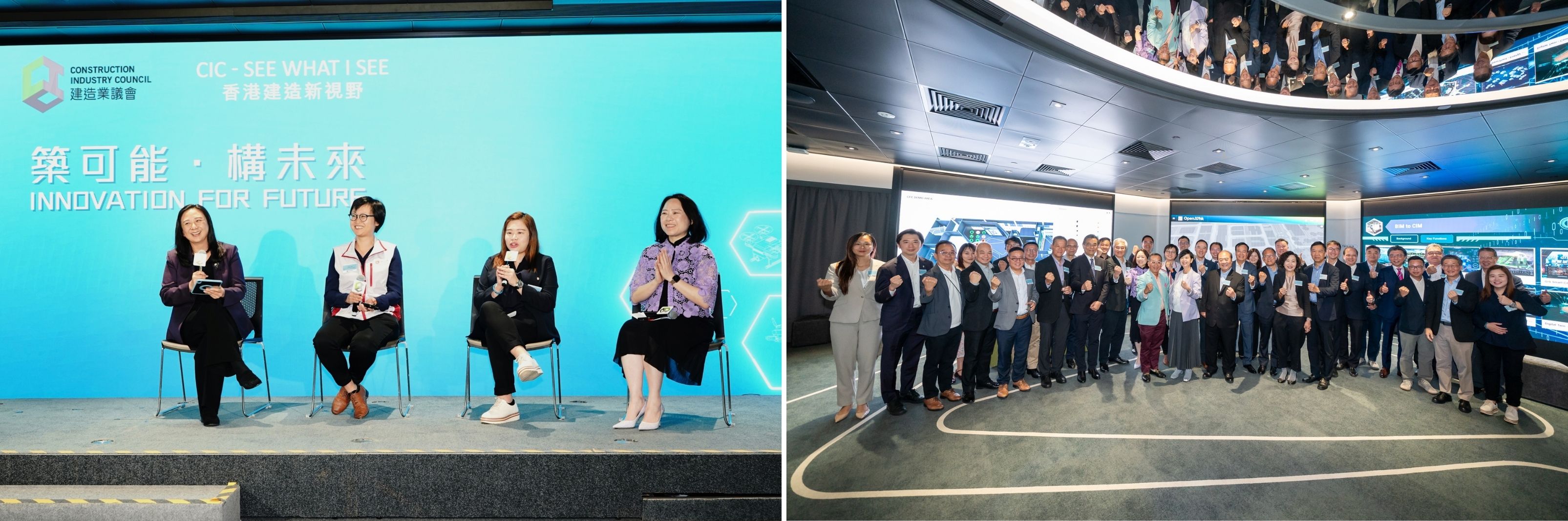
The CIC also invited Legislative Councillor Hon Elizabeth QUAT to chair a panel on which industry elites discussed unique challenges and made suggestions regarding Hong Kong's urbanisation and housing planning. They cited international examples to explore the feasibility of integrating smart technologies and discussed how to strengthen the industry's innovation culture, from investing in new materials to training future leaders.
Ms. Teresa YEUNG, President of the Hong Kong Institute of Planners, pointed out that housing demand in Hong Kong continues to rise. When coupled with limited resources, a rapidly growing population and ageing buildings, this has significantly increased pressure on social infrastructure. "Against this backdrop, we advocate for a 'Smart, Green, Resilient' approach that integrates smart technology, green infrastructure and resilient technologies to create smart, sustainable, people-centred cities that effectively address issues such as mental health, social inclusion and quality of life," she explained.
Ms. Michele LUI, Chairperson of the CIC Youth Affairs Committee, described the younger generation’s belief that the greatest challenge facing older urban areas is ageing infrastructure, and that high demand for transportation is a major issue in the urbanisation process. With creative solutions and modern technology, such as intelligent traffic management, drones, hydrogen-powered autonomous buses, multi-level automated parking and even air taxis, smart mobility can be implemented, and improvements achieved in traffic efficiency and in connecting residential areas more effectively with major commercial districts. Young people expect more liveable communities, so all projects must have a sustainable and strategic development roadmap to revitalise old communities and prepare for new land planning – all while driving the construction industry's development through innovative technology.
Regarding the integrated application of technology, Cr Phyllis CHEN, Chairperson of the Safety, Health and Environment Committee of the Hong Kong Institute of Construction Managers, stated, "The Hong Kong construction industry has adopted a variety of new technologies, such as Building Information Modelling (BIM), MiC and construction robots, placing us at the forefront internationally – something the industry should be proud of.
"Globally, the application of digital technology and AI has become a trend in the construction industry, and we must also move in this direction to promote smarter and more energy-efficient housing development."
CIC has spared no effort to promote innovative technologies. It has organised construction robot competitions and exhibitions to help the Greater Bay Area connect with the world, and hosted a variety of salons at the Centre for Future Construction, all to provide a platform for professionals to exchange knowledge.
To open up new possibilities to shape the future, innovative ideas and technology must complement each other.