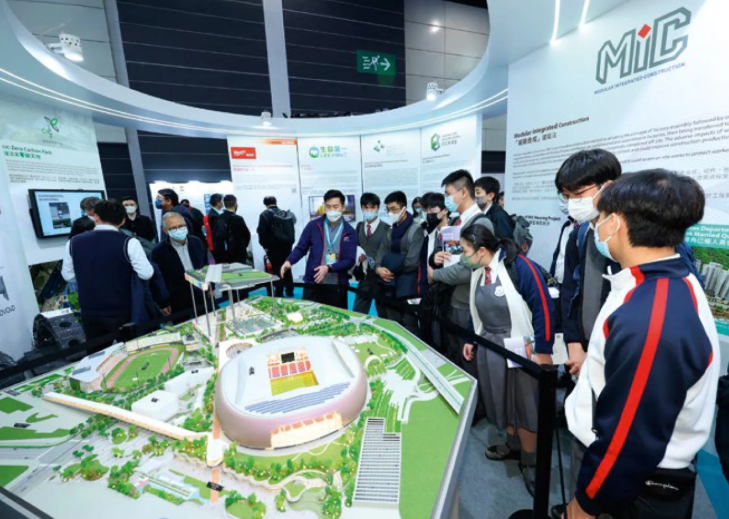
This year's CIExpo is expected to attract around 120 exhibitors, including building technology companies from Hong Kong, Mainland China, Europe, the United States and the Asia-Pacific region. "The Mainland is making rapid progress in construction technology, and many technology companies are actively signing up, which will make the CIExpo a lot more exciting." Cheng mentioned that the CIExpo has an overseas exhibition area, hoping to allow the local industry to learn from the development of overseas places and promote cross-regional technical exchanges and cooperation, and the number of visitors is expected to exceed 20,000, seizing the opportunity of internal and external communication, and becoming an important platform for the local construction industry to connect with international standards.
The results of scientific and technological practice implementation can be seen in detail
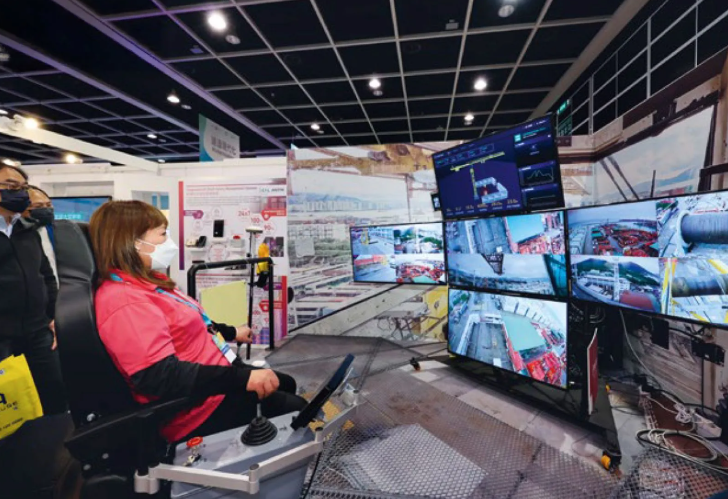
The technology showcased at the CIExpo is by no means imaginative, as the last CIExpo showcased an innovative device called "5G-Enabled Unmanned Tower Crane", which attracted great attention and adoption from the industry after the exhibition. Cheng recalled: "Traditional Libra pilots have to spend half an hour every day climbing to the high cab, and the working conditions are difficult; Remote control technology allows them to operate in a comfortable air-conditioned environment, greatly improving the working environment and avoiding the risk of working at height, which is the real value of innovative technology."
This successful case illustrates the power of the CIExpo to transform technology from theoretical concepts to practical applications, allowing industry users to experience innovative equipment first-hand at the fair and communicate directly with suppliers, facilitating the widespread application of technology. On the one hand, the CIExpo promotes exchanges between local and overseas industry stakeholders, and Cheng also emphasised that the functions of the Council are not only to organise conferences and exhibitions, but also to play a leading role in the industry to pass on innovative knowledge to the industry. With the implementation of technology, in addition to hardware, education and training are also emphasized, so that industry personnel can get things and make use of them. In response to the needs of the industry, the Hong Kong Institute of Construction under the Council has launched new courses such as painting robot training and welding robot operation to help workers upgrade and transform into professional equipment operators. Cheng revealed that workers are now very willing to participate, especially the younger generation, who are more willing to learn new technologies and rely on technology to open up a way out based on traditional crafts.
The Innovation and Technology Fund supports a trilogy to help SMEs implement transformation
To tie in with the application of I&T, the Government established the Construction Innovation and Technology Fund in 2018, which is managed by the Council to support the technological transformation of the construction industry. "The application of technology in the construction industry cannot rely solely on ideas, but also needs financial support." The operation mode of the fund is a "trilogy": first, let SMEs "know and see technology"; subsequent training support; Finally, financial subsidies are provided. To date, the Fund has funded more than 3,000 projects with a funding amount of nearly $1.7 billion, benefiting more than 700 SMEs. This funding model effectively lowers the threshold for SMEs to adopt technology, assisting them in piloting innovative solutions, gradually building their self-investment capabilities, and achieving business upgrades.
With the continuous expansion of support under the Construction Innovation and Technology Fund, the application of technology is becoming increasingly popular in various construction projects. Cheng further gave an example: "The government is very supportive of the popularization of the application of construction technology, and many projects have specified the use of technology, such as plastering and painting with robots." In the "Kwu Tung North and Fanling North New Development Areas" led by the Development Bureau, there is a footbridge made of S960 ultra-high-strength steel, which is the first in the world. The Housing Authority has also introduced housing construction robots in various projects, reflecting that advanced construction technology has moved from demonstration to practical implementation.
Digital Architecture In-depth Process Management with BIM as the core tool
Building Information Modelling (BIM) technology has become a core tool for digital transformation in the local construction industry, covering various aspects such as design, construction, project management, operation and maintenance. The Council has been promoting the adoption of BIM in the industry since 10 years ago, and Cheng said, "Almost everyone knows what BIM is now, and the key is their level of adoption of this technology." Therefore, the Council’s current focus is on promoting the industry to deepen the application of BIM and make it truly internalized as a project management tool.
As for Modular Integrated Construction (MiC), part of the traditional construction process is transferred to factory prefabrication and then hoisted to the site for installation, which not only shortens the construction period but also helps improve quality and environmental benefits. "There are dozens of MiC methods to complete the construction of buildings. This industrial production model marks the transition from on-site construction to standardisation and modernisation of the local construction industry."
Centre for Future Construction to build an innovation and technology experience platform
In addition to the triennial Innovation CIExpo, the Council has also been actively promoting a more sustainable and daily Innovation & Technology (I&T) display and education platform, and recently set up the Centre for Future Construction (CFC) at the Hong Kong Institute of Construction - Kowloon Bay Campus, with the goal of enabling the industry to "frequently engage with and experience the latest technologies" through five themed areas. Among them, Digital Twin technology is one of the core demonstrations of the center, which combines design, construction, and operation and maintenance simulations, allowing users to preview the impact of various design changes on actual construction in a virtual environment. Digital twins can also be used in construction scenario simulation, such as predicting crane layout, construction flow, collision risk, etc., which can improve the efficiency of construction site layout and reduce safety risks. Through simulation calculations, design accuracy and construction efficiency are improved, reducing errors and resource waste."
The Center is also equipped with a 270-degree curved screen immersive space to simulate the construction site environment, allowing managers to observe the site layout and potential problems as if they were in a drone. There is also an artificial intelligence (AI) exhibition area to illustrate how to optimize design, automate construction, and improve logistics efficiency through AI. "We try to teach practitioners how to use AI for design, construction management, transportation and logistics, and even save unnecessary time and expenses. This immersive experience not only enhances sensory understanding but also serves as an essential tool for decision support. By anticipating future construction scenarios, users can make more accurate planning decisions before starting construction, further reducing construction risks and resource waste."
The Centre also displays the Smart Site Safety System (4S) device, which can monitor construction site data in real time to reduce risks. In addition, the robot exhibition area displays a variety of physical equipment, including robotic arms, painting robots, drones, etc., allowing visitors to "see and touch" and truly understand the operation and application scenarios of the technology.
Set up awards to stimulate the potential of the industry
In addition to promoting technology applications, the Council also promotes cultural change in the industry through an annual award system, including the "CIC Construction Innovation Award", "CIC Sustainable Construction Award", "CIC Construction Digitalization Award", "CIC Outstanding Contractor Award", etc., which are held every three years respectively to recognise the industry's innovative practices in design, construction and management. The Council hopes to encourage practitioners to apply technology.
Facing multiple challenges such as an ageing population, strong demand for professional talent, and global competition, the future of the construction industry must be driven by technology and creativity. The dual-track promotion of the CIExpo and the CFC provides a coherent and forward-looking transformation blueprint for the industry. With the increasing popularity of I&T applications, Hong Kong's construction industry is gradually moving towards a new stage of more efficient, safe and sustainable development, injecting new impetus into urban construction and leading the future construction direction.
[Source: https://www.capital-hk.com/interview/corporate-strategy/Interview_CIC_10072025]