

Close

Important Notice

Sorry, no results

Close
 
Close
prev next
CIC CIC CIC CIC
  • News Centre
    • CIC Management Insights
      • From the Chairman
      • Executive Director's Message
    • For Industry
      • News Report
    • For Media
      • Press Release
      • Media Enquiries
    • CIC Management Insights
      • From the Chairman
      • Executive Director's Message
    • For Industry
      • News Report
    • For Media
      • Press Release
      • Media Enquiries
  • Research & Data
    Construction Expenditure Forecast Construction Manpower Forecast Graduate Statistics Statistics of Registered Construction Workers Information on Short-term Labour Supply Prosecution Statistics
    • Construction Expenditure Forecast
    • Construction Manpower Forecast
    • Graduate Statistics
    • Statistics of Registered Construction Workers
    • Information on Short-term Labour Supply
    • Prosecution Statistics
  • Events
  • Resources Centre
  • Quick Links
    • Related Websites
      • Hong Kong Institute of Construction
      • CIC–Zero Carbon Park
      • Construction Sector Imported Labour Quarters
      • Construction Industry Sports & Volunteering Programme
    • Services
      • Workers Registration
      • Trade Test Application
      • Technically Competent Persons Registration Scheme
      • Registered Specialist Trade Contractors Scheme
      • Levy E-service
    • Other Promotions
      • Craftsmanship
      • “Design for Future Build for Life” Construction Hong Kong
      • Become an iClub Member
      • Construction Industry Anti-Heat Stress Uniform
      • Construction Industry Security of Payment Ordinance
    • Related Websites
      • Hong Kong Institute of Construction
      • CIC–Zero Carbon Park
      • Construction Sector Imported Labour Quarters
      • Construction Industry Sports & Volunteering Programme
    • Services
      • Workers Registration
      • Trade Test Application
      • Technically Competent Persons Registration Scheme
      • Registered Specialist Trade Contractors Scheme
      • Levy E-service
    • Other Promotions
      • Craftsmanship
      • “Design for Future Build for Life” Construction Hong Kong
      • Become an iClub Member
      • Construction Industry Anti-Heat Stress Uniform
      • Construction Industry Security of Payment Ordinance
  • Contact Us
  • language
    • EN
    • 繁體
    • 简体
  • About CIC

    About CIC

    We drive for unity and excellence of the construction industry of Hong Kong.

    Learn more

    Menu image

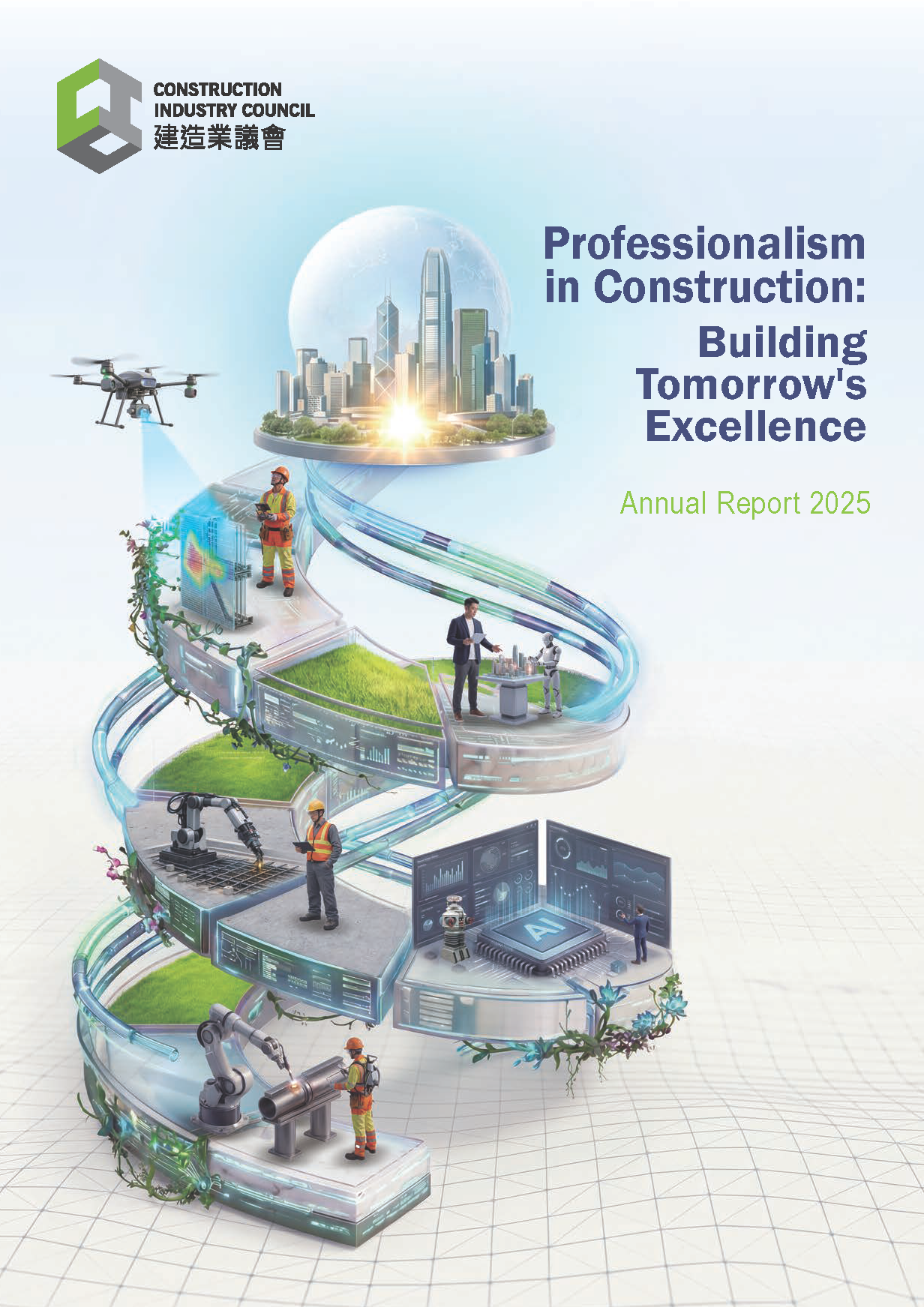
    Annual Report for 2025

    • Corporate Profile
    • Corporate Goverance
    • The Council
    • Boards and Committees
    • Organisation Structure
    • Careers at CIC
    • Publications
    • Construction Industry Levy
      • Overview
      • Levy Collection Procedures
      • Surcharge, Penalty and Offences
      • Objections and Appeals
      • Levy E-service
    • Procurement
      • Application for Inclusion in the CIC Vendor List
      • Tender Details
    • Corporate Profile
    • Corporate Goverance
    • The Council
    • Boards and Committees
    • Organisation Structure
    • Careers at CIC
    • Publications
    • Construction Industry Levy
      • Overview
      • Levy Collection Procedures
      • Surcharge, Penalty and Offences
      • Objections and Appeals
      • Levy E-service
    • Procurement
      • Application for Inclusion in the CIC Vendor List
      • Tender Details
  • Industry Development
  • Training
  • Registrations

    Registrations

    We provide Construction Workers Registration service, and introduce Registered Specialist Trade Contractors Scheme as well as the Technically Competent Persons Registration Scheme to the construction industry.

    Learn more

    Registrations
    • Construction Workers Registration
      • Application for Workers Registration
      • Requirements of Construction Workers Registration Ordinance
      • Construction Workers Registration System (CWRS)
      • Register of Construction Workers
      • Review and Appeal
      • Service Centres
    • Registered Workers Support
      • Medical Examination Scheme for Registered Construction Workers (MES)
      • Job Portal
      • Construction Workers Festival
      • Worker-Friendly Construction Site
      • Outstanding Frontline Supervisor Award
      • Scholarships for Family Members of Registered Workers
      • Construction Workers Professional Development Scheme (CWDS)
      • CIC APP
      • Construction Industry Credit Card
      • Employers Job Portal
    • Registered Specialist Trade Contractors Scheme
    • Technically Competent Persons Registration Scheme
      • About the Scheme
      • How to Apply
      • Technically Competent Persons Registration Scheme Portal
      • Continuous Competence Development
      • Technically Competent Persons List
    • Resources
      • Registration Forms
      • Downloads
      • FAQ
    • Construction Workers Registration
      • Application for Workers Registration
      • Requirements of Construction Workers Registration Ordinance
      • Construction Workers Registration System (CWRS)
      • Register of Construction Workers
      • Review and Appeal
      • Service Centres
    • Registered Workers Support
      • Medical Examination Scheme for Registered Construction Workers (MES)
      • Job Portal
      • Construction Workers Festival
      • Worker-Friendly Construction Site
      • Outstanding Frontline Supervisor Award
      • Scholarships for Family Members of Registered Workers
      • Construction Workers Professional Development Scheme (CWDS)
      • CIC APP
      • Construction Industry Credit Card
      • Employers Job Portal
    • Registered Specialist Trade Contractors Scheme
    • Technically Competent Persons Registration Scheme
      • About the Scheme
      • How to Apply
      • Technically Competent Persons Registration Scheme Portal
      • Continuous Competence Development
      • Technically Competent Persons List
    • Resources
      • Registration Forms
      • Downloads
      • FAQ
  • Trade Tests

    Trade Tests

    The CIC provides trade tests for the construction workers.

    Learn more

    Trade Tests
    • Civil & Building Construction Trades
      • Civil & Building Construction Trade Tests
      • Civil & Building Construction Intermediate Trade Tests
      • Test Schedule
    • Construction-related E&M Trades
      • Construction-related E&M Trade Tests
      • Construction-related E&M Intermediate Trade Tests
      • Test Schedule
    • Trade Test for Grade A Electrical Work
    • Machineries and Crane Operation
      • Construction Crane Operators
      • Loadshifting Machinery Operators
      • Operator of Builder's Lift
      • Persons Working on Suspended Working Platforms
    • Other Assessment
      • Truss-out Scaffolder Safety Training
    • One Examination Multiple Certification
      • GBA Standards (Skilled Workers) Examination
      • GBA Standards (Civil Engineering Supervisor) Examination
    • Trade Test Application for Repair, Maintenance, Alteration and Addition (RMAA) Works
    • Trade Test Application
    • Resources
      • Downloads
      • FAQ
    • Civil & Building Construction Trades
      • Civil & Building Construction Trade Tests
      • Civil & Building Construction Intermediate Trade Tests
      • Test Schedule
    • Construction-related E&M Trades
      • Construction-related E&M Trade Tests
      • Construction-related E&M Intermediate Trade Tests
      • Test Schedule
    • Trade Test for Grade A Electrical Work
    • Machineries and Crane Operation
      • Construction Crane Operators
      • Loadshifting Machinery Operators
      • Operator of Builder's Lift
      • Persons Working on Suspended Working Platforms
    • Other Assessment
      • Truss-out Scaffolder Safety Training
    • One Examination Multiple Certification
      • GBA Standards (Skilled Workers) Examination
      • GBA Standards (Civil Engineering Supervisor) Examination
    • Trade Test Application for Repair, Maintenance, Alteration and Addition (RMAA) Works
    • Trade Test Application
    • Resources
      • Downloads
      • FAQ
  • Safety

    Safety

    Continuously improve the Professionalism, Strengthen the Safety Culture.

    Learn more

    Safety
    • Life First
    • Alerts / Messages
    • Frontline Personnel Safety Performance Recording Scheme
    • Smart Site Safety System Labelling Scheme
    • Safety Related Training Course
    • Design for Safety
    • Accreditation Scheme for Frontline Supervisor Safety Training Course
    • Safety Events
      • Construction Safety Week
    • Resources
      • Safety Videos
      • Guidelines
      • Reference Materials
      • Posters
    • Life First
    • Alerts / Messages
    • Frontline Personnel Safety Performance Recording Scheme
    • Smart Site Safety System Labelling Scheme
    • Safety Related Training Course
    • Design for Safety
    • Accreditation Scheme for Frontline Supervisor Safety Training Course
    • Safety Events
      • Construction Safety Week
    • Resources
      • Safety Videos
      • Guidelines
      • Reference Materials
      • Posters
  • Funding

    Funding

    Joining Hands in Creating a Better Tomorrow

    Learn more

    Funding
    • The Construction Innovation and Technology Fund (CITF)
    • CIC Research Fund
      • Application
      • Funded Projects
    • Construction Industry Council Sponsorship
      • Sponsorship Policy
      • Terms of Reference
      • Supporting Events
    • The Construction Innovation and Technology Fund (CITF)
    • CIC Research Fund
      • Application
      • Funded Projects
    • Construction Industry Council Sponsorship
      • Sponsorship Policy
      • Terms of Reference
      • Supporting Events
  • Search

CIC CIC
Search Menu
  • EN
    • EN
    • 繁體
    • 简体
  • Close

Search

  • Home
  • About CIC

    About CIC

    We drive for unity and excellence of the construction industry of Hong Kong.

    Learn more

    Menu image

    Annual Report for 2025

    • Corporate Profile
    • Corporate Goverance
    • The Council
    • Boards and Committees
    • Organisation Structure
    • Careers at CIC
    • Publications
    • Construction Industry Levy
      • Overview
      • Levy Collection Procedures
      • Surcharge, Penalty and Offences
      • Objections and Appeals
      • Levy E-service
    • Procurement
      • Application for Inclusion in the CIC Vendor List
      • Tender Details
    • Corporate Profile
    • Corporate Goverance
    • The Council
    • Boards and Committees
    • Organisation Structure
    • Careers at CIC
    • Publications
    • Construction Industry Levy
      • Overview
      • Levy Collection Procedures
      • Surcharge, Penalty and Offences
      • Objections and Appeals
      • Levy E-service
    • Procurement
      • Application for Inclusion in the CIC Vendor List
      • Tender Details
  • Industry Development
  • Training
  • Registrations

    Registrations

    We provide Construction Workers Registration service, and introduce Registered Specialist Trade Contractors Scheme as well as the Technically Competent Persons Registration Scheme to the construction industry.

    Learn more

    Registrations
    • Construction Workers Registration
      • Application for Workers Registration
      • Requirements of Construction Workers Registration Ordinance
      • Construction Workers Registration System (CWRS)
      • Register of Construction Workers
      • Review and Appeal
      • Service Centres
    • Registered Workers Support
      • Medical Examination Scheme for Registered Construction Workers (MES)
      • Job Portal
      • Construction Workers Festival
      • Worker-Friendly Construction Site
      • Outstanding Frontline Supervisor Award
      • Scholarships for Family Members of Registered Workers
      • Construction Workers Professional Development Scheme (CWDS)
      • CIC APP
      • Construction Industry Credit Card
      • Employers Job Portal
    • Registered Specialist Trade Contractors Scheme
    • Technically Competent Persons Registration Scheme
      • About the Scheme
      • How to Apply
      • Technically Competent Persons Registration Scheme Portal
      • Continuous Competence Development
      • Technically Competent Persons List
    • Resources
      • Registration Forms
      • Downloads
      • FAQ
    • Construction Workers Registration
      • Application for Workers Registration
      • Requirements of Construction Workers Registration Ordinance
      • Construction Workers Registration System (CWRS)
      • Register of Construction Workers
      • Review and Appeal
      • Service Centres
    • Registered Workers Support
      • Medical Examination Scheme for Registered Construction Workers (MES)
      • Job Portal
      • Construction Workers Festival
      • Worker-Friendly Construction Site
      • Outstanding Frontline Supervisor Award
      • Scholarships for Family Members of Registered Workers
      • Construction Workers Professional Development Scheme (CWDS)
      • CIC APP
      • Construction Industry Credit Card
      • Employers Job Portal
    • Registered Specialist Trade Contractors Scheme
    • Technically Competent Persons Registration Scheme
      • About the Scheme
      • How to Apply
      • Technically Competent Persons Registration Scheme Portal
      • Continuous Competence Development
      • Technically Competent Persons List
    • Resources
      • Registration Forms
      • Downloads
      • FAQ
  • Trade Tests

    Trade Tests

    The CIC provides trade tests for the construction workers.

    Learn more

    Trade Tests
    • Civil & Building Construction Trades
      • Civil & Building Construction Trade Tests
      • Civil & Building Construction Intermediate Trade Tests
      • Test Schedule
    • Construction-related E&M Trades
      • Construction-related E&M Trade Tests
      • Construction-related E&M Intermediate Trade Tests
      • Test Schedule
    • Trade Test for Grade A Electrical Work
    • Machineries and Crane Operation
      • Construction Crane Operators
      • Loadshifting Machinery Operators
      • Operator of Builder's Lift
      • Persons Working on Suspended Working Platforms
    • Other Assessment
      • Truss-out Scaffolder Safety Training
    • One Examination Multiple Certification
      • GBA Standards (Skilled Workers) Examination
      • GBA Standards (Civil Engineering Supervisor) Examination
    • Trade Test Application for Repair, Maintenance, Alteration and Addition (RMAA) Works
    • Trade Test Application
    • Resources
      • Downloads
      • FAQ
    • Civil & Building Construction Trades
      • Civil & Building Construction Trade Tests
      • Civil & Building Construction Intermediate Trade Tests
      • Test Schedule
    • Construction-related E&M Trades
      • Construction-related E&M Trade Tests
      • Construction-related E&M Intermediate Trade Tests
      • Test Schedule
    • Trade Test for Grade A Electrical Work
    • Machineries and Crane Operation
      • Construction Crane Operators
      • Loadshifting Machinery Operators
      • Operator of Builder's Lift
      • Persons Working on Suspended Working Platforms
    • Other Assessment
      • Truss-out Scaffolder Safety Training
    • One Examination Multiple Certification
      • GBA Standards (Skilled Workers) Examination
      • GBA Standards (Civil Engineering Supervisor) Examination
    • Trade Test Application for Repair, Maintenance, Alteration and Addition (RMAA) Works
    • Trade Test Application
    • Resources
      • Downloads
      • FAQ
  • Safety

    Safety

    Continuously improve the Professionalism, Strengthen the Safety Culture.

    Learn more

    Safety
    • Life First
    • Alerts / Messages
    • Frontline Personnel Safety Performance Recording Scheme
    • Smart Site Safety System Labelling Scheme
    • Safety Related Training Course
    • Design for Safety
    • Accreditation Scheme for Frontline Supervisor Safety Training Course
    • Safety Events
      • Construction Safety Week
    • Resources
      • Safety Videos
      • Guidelines
      • Reference Materials
      • Posters
    • Life First
    • Alerts / Messages
    • Frontline Personnel Safety Performance Recording Scheme
    • Smart Site Safety System Labelling Scheme
    • Safety Related Training Course
    • Design for Safety
    • Accreditation Scheme for Frontline Supervisor Safety Training Course
    • Safety Events
      • Construction Safety Week
    • Resources
      • Safety Videos
      • Guidelines
      • Reference Materials
      • Posters
  • Funding

    Funding

    Joining Hands in Creating a Better Tomorrow

    Learn more

    Funding
    • The Construction Innovation and Technology Fund (CITF)
    • CIC Research Fund
      • Application
      • Funded Projects
    • Construction Industry Council Sponsorship
      • Sponsorship Policy
      • Terms of Reference
      • Supporting Events
    • The Construction Innovation and Technology Fund (CITF)
    • CIC Research Fund
      • Application
      • Funded Projects
    • Construction Industry Council Sponsorship
      • Sponsorship Policy
      • Terms of Reference
      • Supporting Events
Home
Back
News Centre
  • CIC Management Insights
    • From the Chairman
    • Executive Director's Message
  • For Industry
    • News Report
  • For Media
    • Press Release
    • Media Enquiries
  • CIC Management Insights
    • From the Chairman
    • Executive Director's Message
  • For Industry
    • News Report
  • For Media
    • Press Release
    • Media Enquiries
Events
Quick Links
  • Related Websites
    • Hong Kong Institute of Construction
    • CIC–Zero Carbon Park
    • Construction Sector Imported Labour Quarters
    • Construction Industry Sports & Volunteering Programme
  • Services
    • Workers Registration
    • Trade Test Application
    • Technically Competent Persons Registration Scheme
    • Registered Specialist Trade Contractors Scheme
    • Levy E-service
  • Other Promotions
    • Craftsmanship
    • “Design for Future Build for Life” Construction Hong Kong
    • Become an iClub Member
    • Construction Industry Anti-Heat Stress Uniform
    • Construction Industry Security of Payment Ordinance
  • Related Websites
    • Hong Kong Institute of Construction
    • CIC–Zero Carbon Park
    • Construction Sector Imported Labour Quarters
    • Construction Industry Sports & Volunteering Programme
  • Services
    • Workers Registration
    • Trade Test Application
    • Technically Competent Persons Registration Scheme
    • Registered Specialist Trade Contractors Scheme
    • Levy E-service
  • Other Promotions
    • Craftsmanship
    • “Design for Future Build for Life” Construction Hong Kong
    • Become an iClub Member
    • Construction Industry Anti-Heat Stress Uniform
    • Construction Industry Security of Payment Ordinance
Research & Data
Construction Expenditure Forecast Construction Manpower Forecast Graduate Statistics Statistics of Registered Construction Workers Information on Short-term Labour Supply Prosecution Statistics
  • Construction Expenditure Forecast
  • Construction Manpower Forecast
  • Graduate Statistics
  • Statistics of Registered Construction Workers
  • Information on Short-term Labour Supply
  • Prosecution Statistics
Resources Centre Contact Us
Careers at CIC Sitemap Privacy Policy & Terms
Tender Details FAQ
Email Facebook Instagram Linkedin YouTube
Home

FAQ

Registrations Trade Tests Construction Expenditure Forecast
Construction Expenditure Forecast
About Construction Workers Registration Ordinance About Application for Construction Workers Registration About Submission of Daily Attendance Records About “Designated Workers for Designated Skills” Provision About Registered Specialist Trade Contractors Scheme About Technically Competent Persons Registration Scheme

Disclaimer

Whilst reasonable efforts have been made to ensure the accuracy of the information contained herein, the Construction Industry Council (CIC) nevertheless would encourage readers to seek appropriate independent advice from their professional advisers where possible. Readers should not treat or rely on such information as a substitute for such independent professional advice.

The information provided below is for general reference only and should not be treated as inclusive of all matters and requirements in relation to the Construction Workers Registration Ordinance (Cap. 583) (CWRO). For a complete statement of the law, direct reference should be made to the CWRO itself. The information provided herein will not affect or prejudice the CIC in performing any of its functions and powers under the CWRO.


Scope of Application

1. What kind of work does the CWRO apply to?

In relation to “construction work”, the CWRO places certain major requirements (see Question 6 onwards below) on various industry participants including but not limited to principal contractors, employers of construction workers and persons personally carrying out construction work. Under the CWRO, “construction work” means:

  1. the construction, erection, installation or reconstruction of any specified structure (“specified structures” are set out in Schedule 3 of the CWRO and include any building);
  2. the addition, renewal, alteration, repair, dismantling or demolition work that involves the structure of any specified structure;
  3. any building operation involved in preparing for the construction work under item (i) or (ii) above;
  4. any building operation, or building services work, forming an integral part of, or rendering complete, the construction work under item (i) or (ii) above;
  5. any building services work that involves the structure of any specified structure; or
  6. any maintenance work, carried out under a term contract for maintenance, of any specified structure of a public body or a specified body (“specified bodies” are set out in Schedule 2 of the CWRO).

2. Are any works excluded from the CWRO?

The definition of “construction work” under the CWRO excludes any building works for which a certificate of exemption is issued under the Buildings Ordinance (Application to the New Territories) Ordinance (Cap. 121), as well as class III minor works and designated exempted works as defined under the Building (Minor Works) Regulation (Cap. 123 sub. Leg. N).

3. Are interior renovation works governed by the CWRO?

If the renovation works to be carried out do not involve the structure of any specified structure as defined under the CWRO, and are not caught by other limbs of the definition of “construction work” of the CWRO, they are not governed by the CWRO.

4. Is the CWRO no longer applicable once the construction works on site have completed?

The CWRO's major requirements for industry participants relate to “construction sites”, which are defined to generally include all places where construction work is, or is to be, carried out, however, exclude such places where the prescribed certificate of completion as referred to in the definition of “construction site” has been issued.  For instance, for building works where section 14(1) of the Buildings Ordinance applies, when the certificate of completion as referred to in the Building (Administration) Regulations has been sent to the Building Authority, the major requirements of the CWRO will no longer be applicable.

5. If an occupation permit has already been issued by the Buildings Department for a new building, does it mean construction works carried out at such building are no longer governed by the CWRO?

Yes, the construction works will no longer be governed by the major requirements of the CWRO after the certificate of completion as referred to in the Building (Administration) Regulations has been sent to the Building Authority, as the building in question would no longer be a “construction site”.


Major Requirements
6. What requirements under the CWRO are applicable to employers of workers?

The major obligations of employers of workers include:

  1. employing only registered construction workers to personally carry out construction works on construction sites;   
  2. except in prescribed circumstances, employing only registered skilled/semi-skilled workers for the designated trade divisions to personally carry out on construction sites the construction works that involve skills of those designated trade divisions; and
  3. when a registered construction worker is arranged to work under the instruction and supervision of a registered skilled/semi-skilled worker of a designated trade division, implementing reasonable measures to ensure the registered construction worker concerned can identify the relevant registered skilled/semi-skilled worker providing instruction and supervision, and informing the registered construction worker concerned of such measures.

7. What requirements under the CWRO are applicable to principal contractors?

The major obligations of principal contractors include:

  1. employing only registered construction workers to personally carry out construction works on construction sites;  
  2. except in prescribed circumstances, employing only registered skilled/semi-skilled workers for the designated trade divisions to personally carry out on construction sites the construction works that involve skills of those designated trade divisions;
  3. when a registered construction worker is arranged to work under the instruction and supervision of a registered skilled/semi-skilled worker of a designated trade division, implementing reasonable measures to ensure the registered construction worker concerned can identify the relevant registered skilled/semi-skilled worker providing instruction and supervision, and informing the registered construction worker concerned of such measures;
  4. establishing and maintaining a register of statements in the specified form to record statements made by registered construction workers who cannot produce their registration cards on demand;
  5. providing on construction sites electronic card reading devices to access the data stored on the registration cards of registered construction workers;
  6. establishing and maintaining daily attendance records (DARs) of the registered construction workers employed to carry out construction work on a construction site for submission to the Registrar via the Construction Workers Registration System; and
  7. submitting copies of 7-day DARs to the Registrar within 2 business days after each period of 7 days.

8. What are common contraventions of the CWRO requirements?

The common contraventions of the CWRO requirements include:

  1. Failing to furnish the Registrar a copy of the DAR within the prescribed statutory period
  2. Employing, or its subcontractor employing, a person who is not a registered construction worker to personally carry out construction work on a construction site
  3. Failing to provide an electronic card reading device on a construction site
  4. Failing to establish and maintain a register of statements

The CIC regularly publishes prosecution statistics on the CIC’s website for reference of the pubic.

9. What are consequences of non-compliance with the CWRO?

Contraventions of relevant requirements of the CWRO may lead to criminal prosecution and are subject to a fine up to level 5 of HK$50,000 in addition to a record of conviction.


Registration Requirement 
10. Who should register as a registered construction worker under the CWRO?

Any person who personally carries out construction work on a construction site is required to be registered as a registered construction worker under the CWRO.

11. Should site foremen and engineers register as registered construction workers if they need to supervise works and/or provide demonstrations on construction sites?

Professional and technical personnel are not required to register as registered construction workers if they carry out their professional duties and functions within their respective disciplines and expertise on construction sites when necessary, but do not personally carry out construction work on construction sites.

For more details, please refer to “Administrative Guidelines on the Applicability of the Registration Requirements to Professional and Technical Personnel”

12. Will there be any consequences for a worker if the worker, not being a registered construction worker, is found personally carrying out construction work on a construction site?

Generally speaking, any person who commits an offence under the CWRO may be prosecuted and is liable to a fine upon conviction.

Any person who is not a registered construction worker and personally carries out construction work on a construction site is liable on conviction to a fine at level 3 of HK$ 10,000. The employer of that person and the principal contractor for the site are liable on conviction to a fine at level 5 of HK$ 50,000.

13. Should registered construction workers bring along their construction workers registration card while working on construction sites?

A registered construction worker should bring along his/her construction workers registration card while carrying out construction work on a construction site.


Register of Statements
14. What is the register of statements used for?

A register of statements shall be maintained by the principal contractor of a construction site for registered construction workers to make statements in the register when they cannot produce their registration cards on demand.

15. Are there any requirements on the format or contents of the register?

It shall be in the specified form (a template of which can be downloaded from the CIC’s website) and any statement made should not be removed from the register at any time before the expiration of 24 months after the date on which the statement was made in the register.

16. What is the consequence for a principal contractor of a construction site who fails to establish or maintain a register of statements?

A principal contractor who fails to establish or maintain a register of statements in accordance with the CWRO may be prosecuted and is liable on conviction to a fine at level 3 of HK$ 10,000.


Card Reading Device
17. Why is it required to provide an electronic card reading device on construction sites?

An electronic card reading device shall be provided by the principal contractor for a construction site to retrieve the electronic data stored in a worker registration card on the site where any construction work has begun. It also facilitates the controller of a site to capture the DAR of the registered construction workers personally carrying out construction work on the construction site.

18. Are there any exclusions from the requirement to provide an electronic card reading device?

Maintenance works carried out under a term contract for maintenance of specified structures of a public body or a specified body, and construction sites where an exemption from providing card reading devices has been granted by the CIC upon application, are excluded from this requirement. Nevertheless, it is important to note that the principal contractor is still required to submit the DAR of the registered construction workers who carry out construction work on the construction site(s) to the Registrar via the Construction Workers Registration System.

19. Can I be granted an exemption from providing an electronic card reading device if no proper place can be found for fixing the device on site?

In these circumstances, principal contractors may consider using a mobile card reading device compatible with the Construction Workers Registration System, such as a mobile phone that meets specified technical specifications, instead of providing a fixed device. After installing the CIC’s DAR app, a mobile phone can be carried around by site personnel to verify workers' registration cards and capture the attendance records of registered construction workers. Thus, in general, physical constraints are not a valid reason for granting an exemption.

20. If my application for exemption from providing an electronic card reading device is granted, does it mean my construction site is also exempted from all the other requirements of the CWRO?

No, the exemption is granted only for the provision of an electronic card reading device. The other requirements, including but not limited to employment of only registered construction workers and submission of DARs, remain applicable.

21. What are the consequences for a principal contractor of a construction site who fails to provide an electronic card reading device on site?

A principal contractor who without being granted an exemption fails to provide an electronic card reading device on a construction site in accordance with the CWRO may be prosecuted and is liable on conviction to a fine at level 3 of HK$ 10,000.


Last Updated: 2026-04-01 10:49:19
1. Who should register as a registered construction worker under the Construction Workers Registration Ordinance (CWRO)?

Any person who personally carries out construction work on a construction site is required to be registered as a registered construction worker under the CWRO.

2. Should site foremen and engineers register as registered construction workers if they need to supervise works and/or provide demonstrations on construction sites?

Professional and technical personnel are not required to register as registered construction workers if they carry out their professional duties and functions within their respective disciplines and expertise on construction sites when necessary, but do not personally carry out construction work on construction sites.

For more details, please refer to “Administrative Guidelines on the Applicability of the Registration Requirements to Professional and Technical Personnel”

3. How many categories of registered construction workers, and how to distinguish their categories?

A worker who (i) is a Hong Kong permanent resident; or (ii) is not subject to any conditions of stay in Hong Kong that he shall not take up any paid or unpaid employment in Hong Kong, can apply for appropriate category of registration based on his/her own technical qualification(s):

Registration CategoryQualifications for Registration

(1)  Registered Skilled Worker

(for designated trade division)


Hold a trade test certificate issued by the Construction Industry Council (CIC) or former Construction Industry Training Authority (CITA) or Vocational Training Council (VTC), or other qualifications as specified by the CWRO (e.g. other recognized registration, certificates or licenses, etc)

Hold a valid Mandatory Basic Safety Training Courses (Construction Work) Card (commonly known as ‘Green Card’)

(2) Registered Semi-skilled Worker

(for designated trade division)

Hold an intermediate trade test certificate issued by CIC or former CITA or VTC, or other qualifications as specified by the CWRO.

Hold a valid Mandatory Basic Safety Training Courses (Construction Work) Card (commonly known as ‘Green Card’)

(3) Registered General Worker

Hold a valid Mandatory Basic Safety Training Courses (Construction Work) Card (commonly known as ‘Green Card’)

4. Which designated trade division can be registered as Registered Skilled Worker / Registered Semi-skilled Worker?

Currently there are 39 designated trades and 142 designated trade divisions in Schedule 1 of CWRO. Please refer to the “List of Designated Trade Divisions”

5. What is a “trade test certificate”?

A “trade test certificate” refers to the certified qualification obtained after passing the trade tests organized by CIC, former CITA or VTC.

Workers with less experience can obtain intermediate trade test certificates after passing intermediate trade tests.

A worker, who has completed specified apprenticeship training and obtained a graduation certificate of apprenticeship, can apply for exemption and obtain a “trade test certificate” from CIC or VTC.

6. What additional information can be registered in Construction Workers Registration Card?

Construction Workers Registration Cards can record specified additional information related to the construction industry, reducing the number of documents workers need to bring for work. Please refer to the “List of Specified Additional Information Allowed to be recorded in Registration Card”

7. What documents are required to apply for a Construction Workers Registration Card?

  • Hong Kong Identity Card (For non-permanent residents: Besides Hong Kong Identity Card, applicants MUST provide a "One Way Exit Permit”, or a passport/travel document containing a valid visa/ entry permit with a Land Slip/ Notification Slip for Conditions of Stay, together with other relevant documents such as an employment contract, which fulfill the criteria and qualifications for registration)
  • Valid Green Card(with at least 30 days validity)
  • Qualification documents of related trade divisions and other related documents (with at least 30 days of validity)
  • (For Card Loss)Hong Kong Police report of lost/stolen property and MUST mentioned the loss of the construction worker registration card(e-Report is acceptable)
  • (For Card Damage)The original damaged registration card
  • In accordance with the Construction Workers Registration (Fees) Regulation, the registration and renewal fee is $100 for 5-year validity

8. Is half of the registration fee required only if a worker holds “other qualifications” (in column 6 of Schedule 1 under the CWRO) of the trade division he/she applies for registration? Why is there such an arrangement?

"Other qualifications" are specific job qualifications required by relevant legislations. Workers are required to pay for the renewal of other qualifications, thus only half of the registration fee will be charged to reduce financial burden on workers.

9. How much is the registration fee of apply for more than one trade division?

For the application for registration of more than one trade division, the registration fee of only one of the trade divisions is required. If the worker holds “other qualifications” of any of his/her trade divisions, the lowest fee will be charged.

10. How can I receive the Construction Workers Registration Card after applying through the CIC APP? How can I check the application status?

The new Construction Workers Registration Card will be mailed to your correspondence address within approximately 10 working days after the application and payment are completed. Please check the online register (www.cic.hk/wregister). You can check the status of your application anytime in the CIC APP by clicking [ Account > My Applications ] .

11. Can the Construction Workers Registration Card be used immediately after receiving it by mail?

After receiving the Construction Workers Registration Card, you need to activate it within 7 days by calling the activation hotline at 3699 8703 (from 10 am to 10 pm) or tapping the card using NFC / manually inputting the card information via the CIC APP by clicking [ Account > Activate CWR Card ] any time.

12. How can I visit the CIC Service Centres for services?

Please make an appointment in advance to visit CIC Service Centres (Kowloon Bay/ Nam Cheong) by the following means:

  • CIC APP(Video Guide: https://www.youtube.com/watch?v=trbrYkLA7Gk)
  • Contact workers registration hotline at 2873 1911(9 am – 6 pm, Mondays to Fridays; Closed Saturdays, Sundays and Public Holidays)

CIC provides e-Services for Worker Registration, HKIC courses, Trade Testing, you can handle your applications conveniently and easily:

  •  Applying through CIC APP for Worker Registration(download link: CIC APP - Construction essentials at your fingertips)
  • Applying through online platform for HKIC courses(Please click: https://apps.cic.hk/hkicopas/Login)
  • Applying through ‘TTOA Mobile App’  for Trade Testing(download link: https://qrco.de/bbTbzD)


Disclaimer

Whilst reasonable efforts have been made to ensure the accuracy of the information contained herein, the Construction Industry Council (CIC) nevertheless would encourage readers to seek appropriate independent advice from their professional advisers where possible. Readers should not treat or rely on such information as a substitute for such independent professional advice.

The information provided below is for general reference only and should not be treated as inclusive of all matters and requirements in relation to Construction Workers Registration Ordinance (Cap. 583) (CWRO). For a complete statement of the law, direct reference should be made to the CWRO itself. The information provided herein will not affect the functions and powers conferred upon the CIC under the CWRO.

1. Does the requirement to submit DARs of workers apply to my project?

If any work to be carried out under your project falls within the definition of “construction work”, and the place where such work is carried out is a “construction site”, as defined in section 2 of the CWRO, the requirement to submit DARs will be applicable to your project.

2. Who is responsible for submitting DARs?

The controller of the construction site is required to submit to the Registrar the DARs of the registered construction workers who carried out construction work on the construction site during the prescribed statutory period (see answer to Question 5 below).

In general, the controller of a construction site refers to the principal contractor for that construction site. If there is no principal contractor, the controller will be any person who has control over or is in charge of the construction site.

3. Who needs to be recorded in a DAR?

All registered construction workers employed to personally carry out construction work on the construction site concerned shall be recorded in the DAR.

4. Is the tapping of cards on an electronic card reading device equivalent to having submitted a DAR?

Tapping cards is not equivalent to submitting a DAR.  By tapping workers’ registration cards on an electronic card reading device, their information is captured and synchronized with the CIC’s cloud if an Internet connection is available. However, the controller of the construction site is then required to log onto the Construction Workers Registration System (CWRS) to verify the completeness and accuracy of the DARs that are synchronized in the CIC’s cloud and confirm submission in order to complete the submission process.

5. When and how often shall I submit DARs to the Registrar?

After any construction work begins on the site, a copy of the DAR in respect of every period of 7 days must be submitted within 2 business days after such 7-day period. The DAR shall contain true and complete records including the number and identity of all registered construction workers, employed by the controller of the construction site or its sub-contractor(s), personally carrying out construction works on the construction site during the recorded period.

6. How do I submit the DARs?

The controller for a construction site is required to submit the DARs to the Registrar through the CWRS.  Please refer to the CWRS User Manual for the operation details.

The key steps of the general submission procedure are outlined as below for ease of reference:

Step 1:apply to create a master account and register the contract in CWRS (https://cwrg.cic.hk/) before any construction work begins on the site.
Step 2:download and install the DAR App to an electronic card reading device
Step 3:maintain and synchronize the Good List (a list of all workers permitted to work on a specific construction site or contract) between the DAR App and the CWRS
Step 4:capture DARs via electronic card reading devices by tapping registration cards when workers report on and off duty on a site
Step 5:upload DARs to the CIC’s cloud by synchronizing automatically or manually when internet connection is available
Step 6:
log onto the CWRS to submit DARs:

- verify all information in the DAR and, if necessary, input/amend the DAR before submission
- rectify invalid DARs, if any, before submission
- click [Submit] and [Confirm] buttons to complete the submission within 2 business days after each 7-day period


7. How can I amend DARs in the CWRS?

Before the due date for submission, the controller of a construction site can log onto the CWRS and make the following amendments manually:

  1. correcting the information contained in a DAR such as the serial number / running number (which is stored in / printed on the workers registration card of a worker), the In/Out Status, the In/Out time from the site and the practising trade code;
  2. adding a DAR of a registered construction worker by entering the registration number and the serial number / running number stored in / printed on his/her workers registration card, the In/Out Status, In/Out date and time from the site and the practising trade code in the CWRS; and
  3. deleting any invalid DAR.
    Please refer to the CWRS User Manual for operation details.

It is important to note that once the due date has passed, all submitted DARs cannot be amended.

8. Under what circumstances should I update the Good List?

The controller of a construction site should update the Good List when:

  1. the practising trade division of an existing worker is changed;
  2. the registration status of an existing worker is changed;
  3. the contract period is extended;
  4. the working period of an existing worker is changed; or
  5. a new worker is added.

9. Do drivers of construction vehicles need to tap their registration cards on electronic card reading devices when they drive into or out of construction sites for carrying out construction works?

In order to capture the DAR of drivers of construction vehicles who carry out construction work on construction sites, they should tap their registration cards at card reading devices. In circumstances where a card reading device cannot be fixed at the vehicular run-in/out of the site, the controller of the construction site may consider using a mobile card reading device to collect the DAR of drivers.

10. My contract is not subject to the DWDS requirement. In these circumstances, am I required to submit DARs to the Registrar?

Yes, even if the requirements under DWDS provisions do not apply, all other requirements of the CWRO, including but not limited to the submission of DARs, are applicable to construction work on construction sites.

11. If the site work is temporarily suspended or no worker is deployed to work on site for a certain period, do I need to submit the DAR for that period?

Even if there were no registered construction workers working on a site during the recorded period, the controller of the construction site is required to continue to submit DARs within 2 business days after each 7-day period after construction works began on the site until the prescribed certificate of completion as specified in the definition of “construction site” under the CWRO has been issued.

The controller of the construction site can simply click [Submit] and [Confirm] buttons in the CWRS to submit a record of zero if there have been no registered construction workers carrying out construction work on the site for the recorded period.

12. If a certificate of completion has already been issued to Buildings Department for my project, do I have to notify the CIC?

A controller of a construction site is not required to submit DARs after the prescribed certificate of completion as referred to in the definition of “construction site” of the CWRO has been issued. In this regard, controllers of construction sites shall notify the CIC of the issue of such certificates by applying for contract completion in the CWRS. Please refer to the CWRS User Manual for operation details.

13. What are the consequences for a controller of a construction site who fails to comply with the requirement to submit DARs?

A controller of a construction site who fails to submit a DAR within the prescribed statutory period, or makes false or misleading information in a DAR, may be prosecuted and is liable on conviction to a fine at level 3 of HK$10,000.


Disclaimer

Whilst reasonable efforts have been made to ensure the accuracy of the information contained herein, the Construction Industry Council (CIC) nevertheless would encourage readers to seek appropriate independent advice from their professional advisers where possible. Readers should not treat or rely on such information as a substitute for such independent professional advice.

The information provided below is for general reference only and should not be treated as inclusive of all matters and requirements in relation to Construction Workers Registration Ordinance (Cap. 583) (CWRO). For a complete statement of the law, direct reference should be made to the CWRO itself.  The information provided herein will not affect the functions and powers conferred upon the CIC under the CWRO.

1. What is the DWDS requirement?

The “designated workers for designated skills” requirement of the CWRO came into effect on 1 April 2017.  It provides that construction works involving the skills of any designated trade division shall be carried out by the registered skilled/semi-skilled workers of that designated trade division, except in prescribed cicumstances.

2. Under what circumstances can a registered construction worker carry out skilled work of a designated trade division while not being registered as a registered skilled/semi-skilled worker of that trade division?

A registered construction worker without registration in a designated trade division is allowed to carry out construction works involving the skills of such designated trade division if :

  1. the worker carries out the work under the instruction and supervision of registered skilled/semi-skilled worker(s) of the relevant designated trade division;
  2. the worker carries out the work under the “working across trade divisions” arrangement as permitted under the CWRO; or
  3. the worker carries out exempted work as specified in the Construction Workers Registration (Exemption) Regulation (Cap. 583C).

3. Does the DWDS requirement apply to maintenance works?

The DWDS requirement is not yet effective for the following works:

  1. maintenance work, carried out under a term contract for maintenance, of specified structures (defined in Schedule 3 of the CWRO) owned by, or otherwise belonging to, a public body or a specified body (defined in Schedule 2 of the CWRO);
  2. construction work (other than maintenance work in item (i) above) under a construction contract in which the total value of all construction operations does not exceed HK$10 million; and
  3. class I & II minor works under the Building (Minor Works) Regulation (Cap. 123N) (Note: Class III minor works are not regulated by the CWRO).

Nevertheless, principal contractors, employers of workers, and construction workers involved in the above construction works are still required to comply with the other provisions of the CWRO that are already in effect (such as providing electronic card reading devices and submitting daily attendance records of workers).

4. Am I required to deploy registered skilled/semi-skilled workers to carry out the work on my site?

To determine whether construction works should be carried out by registered skilled/semi-skilled workers, the following two principles shall apply:

  1. There are currently 142 designated trade divisions as set out in Schedule 1 of the CWRO for workers to register as registered skilled/semi-skilled workers of relevant designated trade divisions according to their qualifications. If the construction work to be carried out does not fall within the scope of the 142 designated trade divisions, in general, workers carrying out such work are only required to register as registered construction workers (which may include registration as registered general workers) to satisfy the registration requirement of the CWRO.
  2. If the construction work to be carried out will involve the skills as specified in the description of skills of a designated trade division in Schedule 1, workers carrying out such work are required to register as registered skilled/semi-skilled workers for the relevant designated trade division, unless they are working under the instruction and supervision of relevant registered skilled/semi-skilled worker(s), carrying out the work under the working across trade divisions arrangement or carrying out exempted work as specified under the Construction Workers Registration (Exemption) Regulation. See also the answer to Question 2 above.

Principal contractors of construction sites and employers of workers are advised to review the whole work process to assess if any skilled work of the designated trade divisions as stipulated in Schedule 1 of the CWRO is involved and deploy the relevant skilled workers to carry out such works as necessary.

5. Should vehicle drivers register as registered construction workers under the CWRO?

Drivers who drive any type of vehicles that are covered by Schedule 1 of the CWRO within, into or out of construction sites for carrying out construction work should be registered as registered skilled workers of the relevant designated trade divisions. In the circumstances that the type of vehicle the driver drives for carrying out construction work is not covered by Schedule 1 of the CWRO, the driver is still required to register as a registered construction worker (which may include registration as a registered general worker).

6. If I am only responsible for transporting construction materials to or from construction sites, do I need to register as a registered construction worker?

No matter whether by vehicle, vessel or other means of transportation, registration as a registered construction worker is not required if a person is only responsible for transporting construction materials to or from a construction site and does not personally carry out any construction work on the site.

7. If I am responsible for transporting construction materials within a construction site, do I need to register as a registered construction worker?

No matter whether by vehicle, vessel or other means of transportation, registration as a registered construction worker is required if a person is responsible for transporting construction materials within a construction site.

8. If skills of different trade divisions are involved in a work process, will it be necessary for a worker performing the work to be registered for all related trade divisions?

Industry practitioners can evaluate the need to deploy registered skilled/semi-skilled workers by referring to the skill descriptions of the 142 designated trade divisions as stipulated in Schedule 1 of the CWRO, the working across trade divisions arrangement in the CWRO and the exempted works specified in the Construction Workers Registration (Exemption) Regulation.

Examples:

The construction of bored piles to be carried out by a Piling Operative (Bored Pile) (C330a) may involve the operation of tremie pipes to facilitate the concreting work.  If the tremie concreting step does not involve the work of a Concreter (C309) according to the description of skills in Schedule 1 of the CWRO, in general, such work might not be required to be carried out by a Concretor (C309).

The construction of bored piles to be carried out by a Piling Operative (Bored Pile) (C330a) may involve jointing reinforcement cages by using mainly clamps and U-bolts.  If the jointing work does not involve the work of a Bar Bender and Fixer (C304) according to the description of skills in Schedule 1 of the CWRO, in general, such work might not be required to be carried out by a Bar Bender and Fixer (C304).

The ground investigation work to be carried out by a Ground Investigation Operator/Driller/Borer (C320) may involve backfilling of the drill hole by delivery of material to fill up the drill-hole.  If only non-pressure grouting work is involved, it is likely not within the skill description of a Grouting Worker (C321), so in general, such work might not be required to be carried out by a Grouting Worker (C321).

9. If the skill involved in the construction work does not appear in Schedule 1 of the CWRO, how do workers register under the CWRO?

If the works to be carried out are out of the scope of the 142 designated trade divisions, in general, workers carrying out such works are only required to register as registered construction workers (which may include registration as registered general workers) to satisfy the registration requirement of the CWRO.

Example:

Erecting and dismantling of tower cranes, operating drilling machines for the construction of soil nails, installing timber supports for excavations in trial pits, operating piling machines (mini-piles / socketed steel H-piles / pipe piles), or installing bearing / movement joints for the construction of bridges do not appear in Schedule 1 of the CWRO. In general, workers carrying out such works might be only required to register as registered construction workers (which may include registration as registered general workers), to satisfy the registration requirement of the CWRO.

10. Do signalmen for hoisting operations or workers performing rigging work have to register as a Rigger/Metal Formwork Erector (C341)?

The description of skills for “Rigger/Metal Formwork Erector” (C341) in Schedule 1 of the CWRO reads “setting up lifting apparatus and equipment for lifting and lowering materials; fixing and dismantling large panel metal formwork”. By its literal meaning, this designated trade division appears to be mainly for workers who fix and dismantle large panel metal formworks and carry out the associated setting up of lifting apparatus and equipment for lifting and lowering materials. In general, signalmen for hoisting operations or workers performing rigging work might be only required to register as registered construction workers (which may include registration as registered general workers) to satisfy the registration requirement of the CWRO.

11. What actions should a principal contractor/employer of workers take so that workers, not being registered under a designated trade division, may carry out works involving skills of that designated trade division?

The principal contractor/employer of workers should:

  1. arrange registered skilled/semi-skilled worker(s) of the related designated trade division to provide instruction and supervision to registered construction workers (not being registered under such designated trade division) to carry out the construction work of the designated trade division; and
  2. implement reasonable measures to ensure that the workers under instruction and supervision can identify the relevant skilled/semi-skilled workers, and inform the workers under instruction and supervision of such measures.

For more details, please refer to:

Guidelines on Arrangement of “Instruction and Supervision” and Code of Practice for Reasonable Measures of “Instruction and Supervision”.

12. Is there any requirement on the ratio of instructors and workers under instruction and supervision? Are they required to work near each other on the construction site?

The principal contractor/employer of workers shall, based on the actual situation of the construction site and the construction works, determine the appropriate number and ratio of instructors and workers under instruction and supervision to ensure that the instructors can effectively instruct and supervise the workers under instruction and supervision. Instructors and workers under instruction and supervision need to be on duty on the same construction site and be able to identify each other (for instance, knowing each other’s name / nickname and contact method). 

13. If workers bring along only their qualification cards such as trade test certificate to perform skilled works independently on construction sites, do they comply with the CWRO?

No.  A trade test certificate is not equivalent to a construction workers registration card.  The CWRO requires workers to hold valid construction worker registration cards while carrying out construction works on site. Only workers with registrations for the required designated trade divisions shown on/stored on their registration cards are allowed to personally carry out the skilled works of the relevant designated trade divisions on construction sites (except in prescribed circumstances as set out in the answer to Question 2 above). 

14. What are the consequences for non-compliance with the DWDS requirement?

Contraventions of the DWDS requirement are criminal offences and are liable on conviction to fines as follows:

  1. Any person who is not a registered skilled/semi-skilled worker of a designated trade division personally carrying out construction work involving the skills of that designated trade division is liable on conviction to a fine at level 3 of HK$10,000;
  2. Any person employing another person who is not a registered skilled/semi-skilled worker for a designated trade division to personally carry out construction work involving the skills of that trade division, as well as the principal contractor of that person, are liable on conviction to a fine at level 5 of HK$50,000;
  3. If a principal contractor or employer of workers fails to implement reasonable measures, or inform the workers under instruction and supervision of such measures, for the arrangement of instruction and supervision, the principal contractor as well as the employer of workers are liable on conviction to a fine at level 3 of HK$10,000.


1. What are the registration requirements?

The Registered Specialist Trade Contractors Scheme (RSTCS) comprising two registers namely the Register of Specialist Trade Contractors and the Register of Subcontractors.  The former register is applicable for Registered Specialist Trade Contractors (RSTC) of twenty-one Designated Trades including concreting, concreting formwork, curtain wall, demolition, erection of concrete precast component, reinforcement bar fixing, scaffolding, plastering, suspended ceiling, tower crane (erecting, dismantling and altering height), building drainage installation, levelling and setting out, building maintenance, interior fitting-out, painting, metal work, structural steelwork, horticultural works, arboricultural works, skyrise greenery works and truss-out scaffolding while the latter register is applicable for Registered Subcontractor (RS) of other common civil, finishing, electrical and mechanical and supporting services trades.

For RSTC applicants, they shall satisfy the registration requirements under the six core elements of safety, management, job experiences, execution, finance and integrity management. For details, please refer to the Rules and Procedures for the Register of Specialist Trade Contractors.

Whereas for RS applicants, they shall continue to adopt the prevailing registration requirements, including completion of at least one job within the last five years, on the list of relevant Government registration schemes or possession of recognised personal qualification by the company proprietor, partner or director. For details, please refer to the Rules and Procedures for the Register of Subcontractors.

2. What kind of information and documents should be submitted when applying for the Scheme?

Apart from business registration and companies registry’s records, RSTC applicants shall provide information of their integrity policy, safety conviction records, management, technical, safety supervisory personnel and long-term employment workers as well as job reference of satisfactory performance and audited financial statements.  RS applicants shall provide prevailing required information and supporting documents. For details, please refer to the Rules and Procedures, application forms and application guidelines of respective Registers.

3. If the Registered Subcontractor has already registered with the relevant Designated Trades of the RSTCS, does it need to separately apply for registration to the Register of Specialist Trade Contractors? What will be the consequence if it fails to fulfill the registration requirements after the grace period?

For those companies already registered with the Designated Trades of the RSTCS, they shall be automatically registered as RSTC Group 1 for the corresponding Designated Trades without the need of separate submission of application. However, they shall fulfill all registration requirements within the 18-month grace period or otherwise with the registration of the relevant Designated Trades be cancelled.

4. If the company has been automatically registered as RSTC Group 1 but want to be registered as Group 2, does it need to submit application separately?

The company shall submit a separate application for change of registration grouping to ensure it meets the registration requirements of RSTC Group 2.

5. How much is the registration fee?

The fee for new and renewal of registration as RSTC is HK$1,300 including HK$100 non-refundable application fee. The registration fee for RS remains unchanged. For details, please refer to the Rules and Procedures and fee schedules of respective Registers.

6. Under what circumstances would regulatory actions be initiated?

Under the RSTCS, regulatory actions on cases such as court conviction or violation of relevant laws, as well as breach of the Rules and Procedures shall be instigated.  When there is a prima facie case, a hearing will be conducted by the Committee on RSTCS.  Regulatory actions imposed would be published on the Scheme Website.  An independent appeal mechanism is established to handle appeal cases.


1. What is Technically Competent Persons Registration Scheme (TCPRS)?

The Construction Industry Council (CIC), in collaboration with the Buildings Department, established the TCPRS which aims to facilitate the appointment and administration of Technically Competent Persons (TCPs) and Competent Person (Logging).  The TCPRS builds a pool of TCPs and Competent Person (Logging) readily accepted by the Building Authority for the purposes of the Code of Practice for Site Supervision 2009 (Supervision Code) and the Buildings Ordinance (Cap. 123).

2. Who are Technically Competent Persons?

According to the Technical Memorandum for Supervision Plans 2009 (TM), TCP means a person whose academic or professional qualifications or experience of buildings works or street works satisfy the requirements set out in the TM and the Supervision Code for a particular type of site supervision or management tasks.

3. Why should I apply for the TCPRS registration?

The TCPRS runs parallel to the current practices of provision of curriculum vitae (CV) of TCPs and Competent Person (Logging) upon submission of supervision plans for individual projects.  It definitely facilitates the appointment of TCPs and preparation and checking of supervision plans as the authorized person (AP), the registered structural engineer (RSE), the registered geotechnical engineer (RGE) or the authorized signatory of the registered contractor (RC) could simply quote the valid registration no. of the proposed TCPs and Competent Person (Logging) instead of submitting their bulky CV when submitting supervision plans to the Building Authority.  The TCPRS encourages TCPs to enhance their quality, skills and knowledge through attending continuous training and development courses.

4. How many types of TCP category(ies) of registration are provided under the TCPRS?

Applications are open to all five grades of TCPs i.e. T1 to T5 as well as Competent Persons (Logging) in 33 categories under 4 functional streams, namely Authorized Person’s Stream, Registered Structural Engineer’s Stream, Registered Geotechnical Engineer’s Stream and Registered Contractor’s Stream.

5. Can I apply for multiple types of TCP categories under the TCPRS?

You may apply for multiple types of TCP categories under different functional streams in one application according to your own qualifications and relevant working experience.  For those applying for inclusion of higher grade of TCPs will also be processed for inclusion together with the lower grade of TCPs in the corresponding types of works within the same stream.

For example, a person who is eligible for registering AP-T4-BW(G)/FW/BW(O), he/she may also register AP-T3-BW(G)/FW and AP-T3-BW(O) in one go. 

6. What are the TCPRS registration requirements?

The registration requirements are the minimum qualifications and experience as set out in Tables 8.4 to 8.8 of the Supervision Code and Practice Note for Authorized Persons, Registered Structural Engineers and Registered Geotechnical Engineers APP-157.

7. What is ‘relevant working experience’?

‘Relevant working experience’ means such working experience of buildings works or street works relevant to the duties of a TCP of appropriate grade under each stream of supervision.  Unless otherwise specified, the relevant working experience must be gained within the previous 5 years (for T1 & T2) or 8 years (for T3, T4 or T5) before application submitted and at least 1 year must be local experience.  For Competent Person (Logging) registration, applicants can provide their relevant working experience gained over the previous years.  For details, please refer to paragraphs 8.22 to 8.24, and Appendix VII of the Supervision Code and Practice Note for Authorized Persons, Registered Structural Engineers and Registered Geotechnical Engineers APP-157. 

8. How should I make a TCPRS application?

All applications are submitted through the TCPRS Portal or its mobile application (TCPRS App).  You can create a user account at the TCPRS Portal and then submit applications by providing all necessary information and documentary proof.

9. What information and documents are required for TCPRS application?

Applicants should provide their personal particulars and details of relevant working experience, and submit the documentary proof of the academic and professional qualifications for application as set out in the Supervision Code.  For applicants applying for Competent Person (Logging) registration, they should also provide supporting documents showing that the course content of their degree obtained comprised enough geological based subjects (if they are not a degree holder in geology) and documentary evidence in support of their core logging experience.  For details, please refer to Appendix VII of the Supervision Code.

Upon initial screening of applications, eligible applicants will be invited to make an appointment at one of the CIC Service Centres.  They will have to present their Hong Kong Identity Card and the original/ certified true copy of the submitted documentary proof, take their e-registration card photo and provide a signature sample for their registration.

Applicants should complete the relevant application procedures before the due date specified by the CIC; otherwise, the application will be deemed as withdrawal unless the CIC’s prior approval has been obtained.

10. How long will the registration last?

The validity period for the registration is 5 years.

11. How much is the registration fee?

The registration fee is waived until further notice.

12. If I obtained additional qualifications or relevant working experience, can I register additional category(ies) under the same stream or other stream(s) while holding a valid registration?

Yes, you may apply for additional category(ies) through the TCPRS Portal or TCPRS App with sufficient information/documentary proof(s). 

13. How can I make an appointment at CIC Service Centre?

Eligible applicants will receive an email notification for appointment.  They may make an appointment within 14 days through TCPRS Portal or TCPRS App.  The location and address of the CIC Service Centres are available at the CIC website.

14. How can I check my application status?

You can check the application status via the TCPRS Portal or TCPRS App.

15. How to check whether a person has been registered under the TCPRS?

A list of TCPs registered under the TCPRS (TCP List) is available at the CIC website.  A hyperlink to the CIC website is also available in the BD website.  You may ascertain a TCP's registration by searching his/her particulars such as names, registration no., accepted types of TCP categories and validity period from the TCP List.

16. Is there any registration card for my TCPRS registration?

Registered TCPs may find their e-registration card at the TCPRS App which provides registration details including their name, portrait, registration no., accepted types of TCP categories, validity period, etc.

17. How many Continuous Competence Development (CCD) hours should be obtained during the TCP Registration validity period?

Each registered TCP or Competent Person (Logging) is recommended to obtain a total of 20 CCD hours during each validity period of the registration.  For each year during the 5-year period, the registered TCP or Competent Person (Logging) should undertake at least 2 hours CCD.

18. Can I record my CCD hours through the TCPRS Portal and mobile App?

Registered TCPs and Competent Person (Logging) could store his/her CCD details, including course name, course content, date of course, etc., through the TCPRS Portal and mobile App under ‘My Details’ module.

19. What are the recommended CCD modes?

Eligible modes cover webinars, seminars/conferences, workshops, and technology exhibitions held by trade associations, professional institutions, Government departments and non-governmental organisations. If a registered TCP or Competent Person (Logging) is also a member of Hong Kong Institution of Engineers, Hong Kong Institute of Architects and / or Hong Kong Institute of Surveyors and undertake the respective Continuous Professional Development (CPD) courses, those CPD hours could also be recognised if they could prove their valid memberships.


General Questions

1. How to apply for trade tests?

You can download and fill the Application Form (Annex 1) and submit with one of the following methods:

  1. By mail; or
  2. In person (Location information refer to Introduction Booklet, P.9); or
  3. Use TTOA Mobile App 

Scan QR code or click here to download directly.

2. What types of documentary proofs for work experience would be accepted in applications?

Answer:

For application of Intermediate Trade Test (ITT), the following types of documentary proofs would be accepted:

  1. documentary proof(s) from employer(s); and/or
  2. a declaration or oath/affirmation made by the applicant at one of the Home Affairs Enquiry Centres; and/or
  3. specified form(s) signed by the Chairman/Vice-chairman of one of the recognised Labour Unions under the CIC Ordinance.


For application of Trade Test (TT), the following types of documentary proofs would be accepted:

  1. documentary proof(s) from employer(s); and/or
  2. a declaration or oath/affirmation made by the applicant at one of the Home Affairs Enquiry Centres.

However, documentary proof issued by Labour Unions will NOT BE ACCEPTED in Trade Test (TT) applications.


Please refer to Download Area for reference forms and list of recognised Labour Unions.

3. Are there any limitations on the bridging courses for trade test applications?

The most updated recognised bridging courses or institutions for trade test application are available in the Download Area.

4. What resources is available for candidates to prepare for trade tests?

Candidates can go to the CIC website as well as the TTOA app to get the Trade Test Preparation Tips. The contents include:

  1. Trade Testing Tips Videos, including Construction Trade Testing Agent with information on trade testing tips, common mistakes and revision kit
  2. Mock Test Papers for different trade tests

Candidates can get themselves better prepared in just around 20 minutes.

Scan the below QR code and subscribe HKCITTC YouTube Channel now!


5. How to request for trade test rescheduling?

Candidates may submit a written request specifying the reason to the Hong Kong Construction Industry Trade Testing Centre (HKCITTC) for the trade test rescheduling at least 3 working days before the test. If the reason is accepted by the HKCITTC, the candidate can reschedule 1 time for free.

6. How to request for a refund?

All test fees are non-refundable. Candidate may submit a written request to the HKCITTC for refund under exceptional circumstances at least 3 working days before the test. The HKCITTC will consider the request at discretion. The paid fee, after deducting an administration fee amounting to 20% of such fee, will be refunded upon approval. 

7. What information should be included in the written request with regard to reschedule/ absence/ refund / change of trade tests?

The written request should include the following information includes:

  1. Applicant’s name
  2. Contact number
  3. HKID No.
  4. Issue(s) to notify the HKCITTC, e.g. reason of reschedule/ absence/ refund / change of trade tests, etc.
  5. Date of application
  6. Applicant’s signature
  7. Additional reference documents like copy of trade testing schedule notice, medical certificate or etc.

8. How to submit the written request?

The written request can be submitted with the following methods:

  1. By Fax to 21009090
  2. By WhatsApp or WeChat to 57200072
  3. By Email to hkcittc@cic.hk
  4. By Mail to Construction Industry Council, address: 38/F, COS Centre, 56 Tsun Yip Street, Kwun Tong, Kowloon, Hong Kong

9. How to apply for exemption of trade test?

Applicants can apply for exemption of specific Civil and Building Construction Trade Tests and Construction-related Electrical and Mechanical Trade Tests. (For exemption details, applicable trades and application method, please refer to the Introduction Booklet, P.17).

10. What are the adverse weather or extreme conditions arrangements?

Black Rainstorm Warning Signal or Tropical Cyclone Signal No.8 (or above) or Extreme Condition: If the signal remains hoisted at/after 6 a.m., the full-day and AM test sessions will be cancelled. If the signal remains hoisted at/after 10:30 a.m., the PM test session will be cancelled. The HKCITTC will not inform the candidates separately.

If the weather conditions deteriorate during the test or any thunderstorm will affect the continuation of the test, or if the Hong Kong Observatory issues the Tropical Cyclone Signal No.8 (or above) / Black Rainstorm Warning / any Extreme Conditions during the test, the HKCITTC reserves the right to terminate the test.

All the outdoor tests are subject to actual weather conditions or special conditions and the HKCITTC reserves the right of final decision.

The HKCITTC will inform the candidates by phone or in writing about rescheduling within 3 working days.

The adverse weather arrangement is applicable to civil and building construction trade tests, construction-related electrial and mechanical trade tests, trade test for Grade A electrical work, certification tests for machineries and crane operation, and truss-out scaffolders safety training.

11. How to collect the certificate?

The certificate card will be mailed together with the pass/collection notification letter.


About Re-sit Application of Trade Tests

12. What is the arrangement for re-sit application if the candidate failed in both written and practical tests?

Candidates may apply for a re-sit, which includes both written test and practical test.

For candidates who fail the practical test and the test result is far below the passing requirements, they are advised to continue practicing their skills in the field before applying for a re-test. In this situation, candidates of Intermediate Trade Test (ITT) (or Trade Test (TT)) applying for a re-sit within 6 months (or 1 year), they are required to pay a surcharge of HK$500 (or HK$1,000) per test. The surcharge will be refunded upon achievement of an overall pass result in the related trade test.

13. If the candidate passed the written test but failed in practical test, may he/she apply for re-sit for practical test only?

Candidates may apply for re-sit for practical test only. The re-sit application fee for practical test would be identical to the application fee of that test. The written test result is valid for 3 years and there is no limitation on the number(s) of re-sits and intervals between any attempts of the practical test(s). 

For candidates who fail the practical test and the test result is far below the passing requirements, they are advised to continue practicing their skills in the field before applying for a re-test. In this situation, candidates of Intermediate Trade Test (ITT) (or Trade Test (TT)) applying for a re-sit within 6 months (or 1 year), they are required to pay a surcharge of HK$500 (or HK$1,000) per test. The surcharge will be refunded upon achievement of an overall pass result in the related trade test.

14. If the candidate passed the practical test but failed in written test, may he/she apply for re-sit for written test only?

Candidates may apply for re-sit for written test only. The re-sit application fee for written test is HK$100. The practical test result is valid for 3 years and there is no limitation on the number(s) of re-sits and intervals between any attempts of the written test(s).


About the Adjustment of Application Requirement (Effective from 1 Jan 2020)

17. What is the working experience requirement after the adjustment?

For application of Intermediate Trade Test (ITT):

  • having at least 2 years' relevant working experience


Work experience to be supported by:

  • documentary proof(s) from employer(s); and/or
  • a declaration or oath/affirmation made by the applicant at one of the Home Affairs Enquiry Centres; and/or
  • specified form(s) signed by the Chairman/Vice-chairman of one of the recognised Labour Unions


For application of Trade Test (TT):

Satisfy one of the following requirements:

  • having at least 4 years' relevant working experience with documentary proof(s); or
  • possessing corresponding Intermediate Trade Test (ITT) qualification with at least 2 years' post-qualification relevant working experience


Work experience to be supported by

  • documentary proof(s) from employer(s); and/or
  • a declaration or oath/affirmation made by the applicant at one of the Home Affairs Enquiry Centres

However, documentary proof issued by Labour Unions will NOT BE ACCEPTED in Trade Test applications.


Please refer to Download Area for reference forms and list of recognised Labour Unions.

18. What areas does the written test cover?

The written test covers the below areas:

  • Construction safety knowledge
  • Technical knowledge of trade concerned
  • Relevant laws and codes of conduct
  • Application knowledge of relevant tools and machineries
  • Professional ethics


Candidates can get themselves better prepared using the Trade Test Preparation Tips.

15. What is the purpose of adjustment in application requirements in construction trade testing?

The purposes of the adjustment are:

  • to ensure candidates possessing the required skills level and practical experience by adjusting the application requirements (including work experience and proof) and introducing written tests for intermediate trade tests; as well as
  • to encourage candidates having good understanding of their needs in taking the test and craftsmanship levels prior to application, which could allow the HKCITTC to deliver more efficient trade testing services for workers with genuine needs.

16. What are the adjustment of application requirements of construction trade testing?

The adjustment of application requirements includes 1) working experience and its proof and 2) the introduction of written test for all Intermediate Trade Tests and Trade Tests. 


About Classification

1. What is the classification of the forecasts?

The forecasts are divided into two types of construction works, i.e. “Public Sector” and “Private Sector”. The detailed classifications are summarized as follows:

Public Sector:

  1. Building Works
  2. Civil Engineering Works
  3. Repair, Maintenance, Alteration and Additional (RMAA) Works
  4. Electrical and Mechanical (E&M) Works

Private Sector:

  1. Building Works
  2. Repair, Maintenance, Alteration and Additional (RMAA) Works
  3. Electrical and Mechanical (E&M) Works

2. What kind of construction works is included in the above classification?

Public Sector:

  1. Building Works – It mainly covers all capital building projects funded by the Government, including works under Architectural Services Department (ArchSD) and Housing Authority and sub-vented projects such as school / hospital projects etc.;
  2. Civil Engineering Works – It mainly covers all capital civil engineering / major infrastructure works under various works departments such as Civil Engineering and Development Department (CEDD), Drainage Services Department (DSD), Environment Protection Department (EPD), Highways Department (HyD), Water Services Department (WSD) etc. and other infrastructure works under Airport Authority and Mass Transit Railway Corporation (MTRC);
  3. Repair, Maintenance, Alteration and Additional (RMAA) Works – RMAA works mainly cover the routine maintenance, term contracts, minor works and improvement works funded by the Government; and
  4. Electrical and Mechanical (E&M) Works – E&M works are proportionally and separately listed. The direct E&M works under Electrical and Mechanical Services Department are also included.

Private Sector:

  1. Building Works – It mainly covers all private construction works including commercial and residential buildings, shopping centres, industrial factories, hotel developments, and residential developments under Urban Renewal Authority, MTRC, Housing Society and building activities under utility companies etc;
  2. Repair, Maintenance, Alteration and Additional (RMAA) Works – It mainly covers all renovation works, fitting-out works and miscellaneous building maintenance works funded by private developers, private companies and incorporated owners. RMAA works under the Operation Building Bright Scheme, Mandatory Building Inspection Scheme and Mandatory Window Inspection Scheme, etc. are also included; and
  3. Electrical and Mechanical (E&M) Works – Similar to public works, E&M works are proportionally and separately listed. Basically, it covers electrical and mechanical fitting works and repair and maintenance of E&M works for private sector.

3. What are the exclusions in the forecasts?

In general, pre-construction feasibility study and design fee, project planning & management fee and supervision fees are not included.


About Methodologies and Assumptions

4. What are the limitations and factors to be considered?

It would be quite difficult to provide a long-term forecast which will be affected by many factors. Externally, the forecasts will be affected by change in economic climates, government policy changes etc. Internally, construction work progress will be affected by many factors, such as statutory procedures, technical reasons, inclement weather etc. With these factors taken into consideration, we consider that it is more appropriate to provide a range for the construction expenditure forecasts for industry’s reference.

5. Why are the forecasts presented in “Mid-term” and “Long-term” forecasts?

The first 5 year forecast is based on the mid-range forecast of the Government and those readily available information, such as past records obtained from the Government (e.g. number of approvals of submissions, consents of work commences, etc.) and sources from property consultants and land sale records etc.

For the second 5 years, the forecasts for public and private sectors are not separately listed. Regarding the Private sector, it is reasonable to assume that the private workloads would grow with the Hong Kong economy and the construction output was tied in with the GDP growth according to the latest economic outlook. In the long run, as the projections depend on many unforeseeable events, hence it is recommended to combine the information for public and private sectors.

6. Why are the forecasts presented in an envelope and what are the criteria of setting the upper bound and lower bound envelope?

As the forecasts will depend on many factors, such as new Government initiatives, change of economic climates, interference of work programmes due to various reasons, etc., to better illustrate our projections, the construction expenditure forecast is presented in an envelope.

As the accuracy of forecasts in the long run will depend on even more unpredictable events, the forecasts of the second 5 years for public and private sectors is grouped together for industry’s reference.

7. Why is the information presented in constant price (e.g. Sep 2012 price level) not using the Money-of-the-Day (MOD) approach?

For easy comparison, all forecasts are presented in constant prices. Since it is not easy to project the inflation change in economy the coming years, hence, no inflation is provisioned within the forecasts. Stakeholders may make their own assumptions on inflation rates.

8. How has the historical data been used to forecast the future figures?

Reference has been made to past records obtained from the Government Departments (e.g. Census and Statistics Department, Buildings Department etc) and the historical data obtained from professional consultants etc.

It is understood that those past data could be used as a reference only, it does not necessarily mean that there exists a relationship between the past data and the future projection. In this connection, this projection would be subject to periodic reviews.

9. How often will the forecasts be released, updated or reviewed?

The forecasts will be released on a yearly basis, or as otherwise deemed necessary.


Others

10. Has the construction expenditure of other regional cities (e.g. Macao) been included in the model?

The projection of construction expenditure of other regional cities has not been included as it is outside CIC's jurisdiction.


CIC
Email Facebook Instagram Linkedin YouTube
Scan to get the app

Scan to get the app

CIC APP Store CIC APP Store CIC APP Google Play CIC APP Google Play CIC Huawei APP Gallery CIC Huawei APP Gallery CIC APP APK CIC APP APK
2024 HKMA Quality Award Caring Organisation CO Advanced Performance Logo Eng Hong Kong Happy Company Good MPF Employer Family-Friendly Employers Silver Award Inclusive Organisation Industry Cares Good Employer Charter 2024 Supportive Family-Friendly Good Employer ERB Manpower Developer Award
Careers at CIC Tender Details Sitemap FAQ Privacy Policy & Terms
Copyright © 2024 (CIC). All Rights Reserved.